Overview
Launch of a Real-World Image Dataset for Ten Durian Diseases in the Mekong Delta
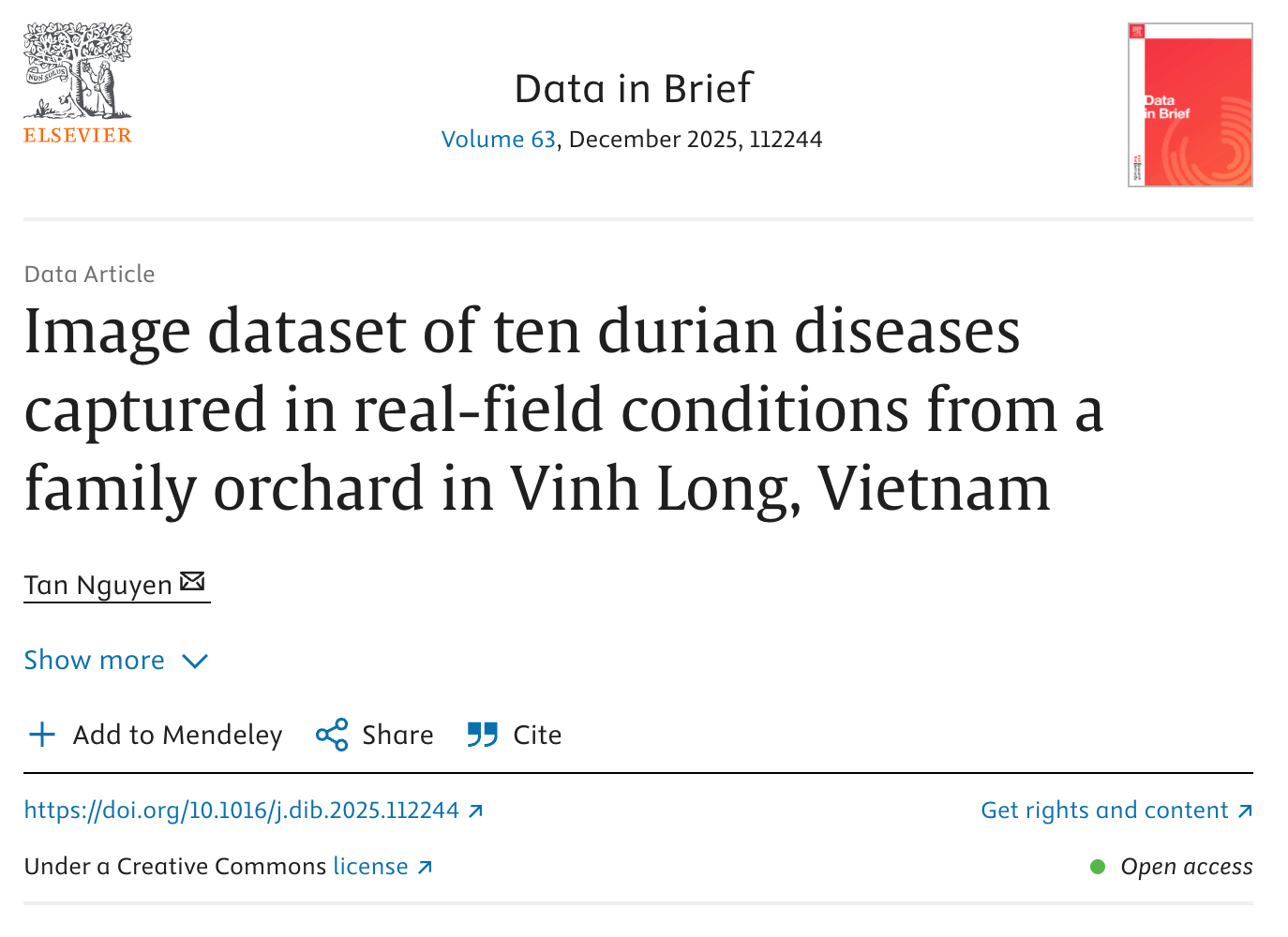
A new open-access dataset with high practical value for precision agriculture has just been published in Data in Brief (ScienceDirect). The dataset focuses on durian, one of Vietnam’s most economically important fruit crops, and aims to support research and applications of artificial intelligence (AI) for real-field plant disease diagnosis.
Dataset Overview
- The dataset is titled Image Dataset of Ten Durian Diseases Captured in Real-Field Conditions from a Family Orchard in Vinh Long, Vietnam.
- Images were collected in a family-owned durian orchard and neighboring farms in Vinh Long Province, Vietnam.
- The related paper was published in Data in Brief (Elsevier) in 2025.
- The dataset contains 5,452 disease images.
- Images cover leaves, flowers, branches, trunks, and roots.
- Photos were captured with an iPhone 14 under natural field conditions.
Key Characteristics
Images taken in real orchards
Diverse lighting conditions and backgrounds
Natural noise such as soil, weeds, and shadows
- Preprocessed PNG images are ready for machine learning.
- The dataset is publicly available on Mendeley Data for research and development.
Why Is This Dataset Important?
Unlike many existing agricultural image datasets that are collected in controlled laboratory environments, this dataset was captured directly in real orchards. This makes it particularly valuable for training deep learning models that can perform reliably in real-world farming conditions.
The dataset closely reflects how farmers actually take photos using smartphones in the field, improving the robustness and real-life applicability of AI-based plant disease detection systems.
Dataset Details and Image Processing
Covers 10 common durian diseases
Each disease class contains approximately 405–427 original images
Photos were taken from multiple angles and distances
Lighting conditions vary naturally throughout the day
Backgrounds are complex and unstructured
Images were manually reviewed and cropped to focus on disease symptoms
Converted to PNG format for consistency and compatibility
Images can be resized (e.g., 224 × 224 pixels) depending on model requirements
- The dataset covers ten common durian diseases.
- Images were captured from multiple angles and distances in natural light.
- Images were reviewed, cropped, and converted to PNG format.
Ways to Use This Dataset
It is especially suitable for projects aiming to deploy AI solutions directly to farmers and agricultural practitioners.
- Training AI models for automatic durian disease classification
- Developing mobile applications for on-site disease diagnosis
- Research in computer vision and agricultural AI
- Studying image classification under noisy, real-world conditions